
Icarus Memoir

Diaries and Perspectives of a Work-in-Progress Truth-Seeker

  • Chapter 3: The Flight of the Paper Balloon

    Chapter 3: The Flight of the Paper Balloon

    Protecting the Golden Spark Against the Weight of the World

    Read on Substack

    The book was a gift from a kindred spirit, My Sweet Orange Tree by José Mauro de Vasconcelos. As Icarus turned the pages, he found more than words; he found a mirror. When he reached the passage titled “The First Paper Balloon,” the reflection shattered him. He wept for Zezé, but mostly, he wept for the recognition of a shared wound. It was the ache of a child who pours his soul into a fragile creation, only to have it grounded by the weight of an unfair world. Icarus knew that gravity well. He had felt his own wings clipped long before he ever learned to fly.

    Zezé: “You see, Gloria? I hadn’t done anything wrong. When I deserve it, it doesn’t matter to me whether they beat me or not. But this time, I hadn’t done anything bad.”

    Gloria sighed.

    Zezé: “The saddest part of all is my balloon. It would have been so beautiful. Ask Luis.”

    Gloria: “I’m sure it would have been a very beautiful balloon. But don’t worry. Tomorrow we’ll go to Dindinha’s house and buy some silk paper. I’ll help you make the most beautiful balloons in the world. So beautiful that the stars will be jealous of them.”

    Zezé: “Gloria, it doesn’t matter anymore. The first balloon a person makes is always the most beautiful. If you don’t succeed at that one, you never will, or you just won’t have the heart to try again.”

    Zezé’s balloon was Icarus’s wings, a dream made of silk and hope, meant to touch the sun but destined to be torn down by those who feared the heights. To the world, it was just paper; to the boy, it was his entire capacity to believe. For twenty years, Icarus wandered through the shadows of that disappointment, struggling to forgive a life that seemed designed to break the brave.

    Yet, deep within the man, the boy remained. He was the golden spark of curiosity, the defiant laughter that refused to be silenced, and the stubborn “No” to a world of grey expectations. Society is a labyrinth built of “shoulds” and “musts,” a maze designed to convince the dreamer that his wings are a delusion and his spirit must be tamed.

    That day, looking at the wreckage of Zezé’s first balloon, Icarus made a sacred pact with his younger self. He realized that while the sun might melt the wax, only silence could kill the spirit.

    Never,” he whispered to the child within, “shall I let you down.

    He chose then to be the guardian of his own light. He would be the one to provide the silk and the warmth, to believe in the flight when the sky looked empty. He would protect that boy’s right to dream of the stars, ensuring that even if the first balloon was lost, the heart would always find the courage to build another.

    [Read from the beginning: Chapter 1: The Wax and the Wire]

  • Chapter 2: The Gravity of Grace

    Chapter 2: The Gravity of Grace

    Falling from the Sun to Find the Earth

    Read on Substack

    “Move closer, little ones. Yes, even you, Leo, tuck those restless feet under the blanket. I have a story to tell you, and it’s not the one your teachers tell. They like to speak of Icarus as a warning, don’t they? A clumsy boy who failed to stay in the sky. But they have it wrong.”

    Elena whispered, “Didn’t he fall because he wasn’t good enough?”

    The old man’s eyes caught the amber light. “The world was cruel to him not because he fell, Elena, but because of how brightly he started. As a teenager, Icarus was the ‘golden boy.’ His mind was a flash of silver; he understood the stars before he could even reach for them. Teachers whispered his name like a promise, seeing him as a rocket destined to outshine the sun.”

    He sighed, the weight of memory heavy in the room. “Then came his twenties, and the sprint became a crawl. The master of the sky found himself trapped in a labyrinth of a degree that wouldn’t end. One year stretched into six. While his peers built towers and wore crowns, Icarus sat in silence, staring at math he couldn’t solve, lost in the woods of his own ‘failure.’”

    “Did people talk?” Leo asked.

    “Louder than the wind,” the man replied. “They called him a tragedy of lost velocity. They judged him for walking when he should have been flying. Even Icarus, looking at his wax-stained hands, felt the burning shame of wasted potential. He thought he had lost his way.”

    The old man leaned forward, a knowing smile playing on his lips. “But the world didn’t see what lay at the water’s edge. If his wings had been as sturdy as expected, he would have remained a prisoner of the sky. He would have chased a sun that offers light but no warmth, soaring high and oblivious to the treasures hidden in the shadows of the earth.”

    “The girl?” Leo guessed.

    “Exactly. If he had been perfect, if he had won every race and graduated with the sun still in his eyes, his path would have remained a straight, lonely line. He would have flown right over the very shore where his soul was waiting. The melting of his wings wasn’t a failure of talent; it was a deliberate gravity. Every mistake, every extra year of struggle, was a stitch undone. It was stripping him of false heights until he was finally heavy enough to land.”

    He looked at the dark window. “When he washed ashore in his mid-twenties, he wasn’t looking for a trophy. He was looking into the eyes of his perfect companion. While the other ‘gifted’ children were burning themselves out against the sun, he was standing on solid ground with the only person who mattered. The six years of struggle weren’t a delay; they were a pilgrimage. He realized he hadn’t been falling behind; he had been arriving. He looked at his scarred shoulders and whispered, ‘I have received the reward for every plummet.’

    He patted Elena’s hand gently. “So, when you fail, and you will, do not weep for the feathers you lose. Celebrate the wings that fail you. For there is a specific kind of mercy in the fall that drops a person, broken and breathless, exactly where they were always meant to be. Sometimes, the earth feels much better than the sky.

    [Read from the beginning: Chapter 1: The Wax and the Wire]
  • Chapter 1: The Wax and the Wire

    Chapter 1: The Wax and the Wire

    High Altitudes on a Borrowed Signal

    Read on Substack

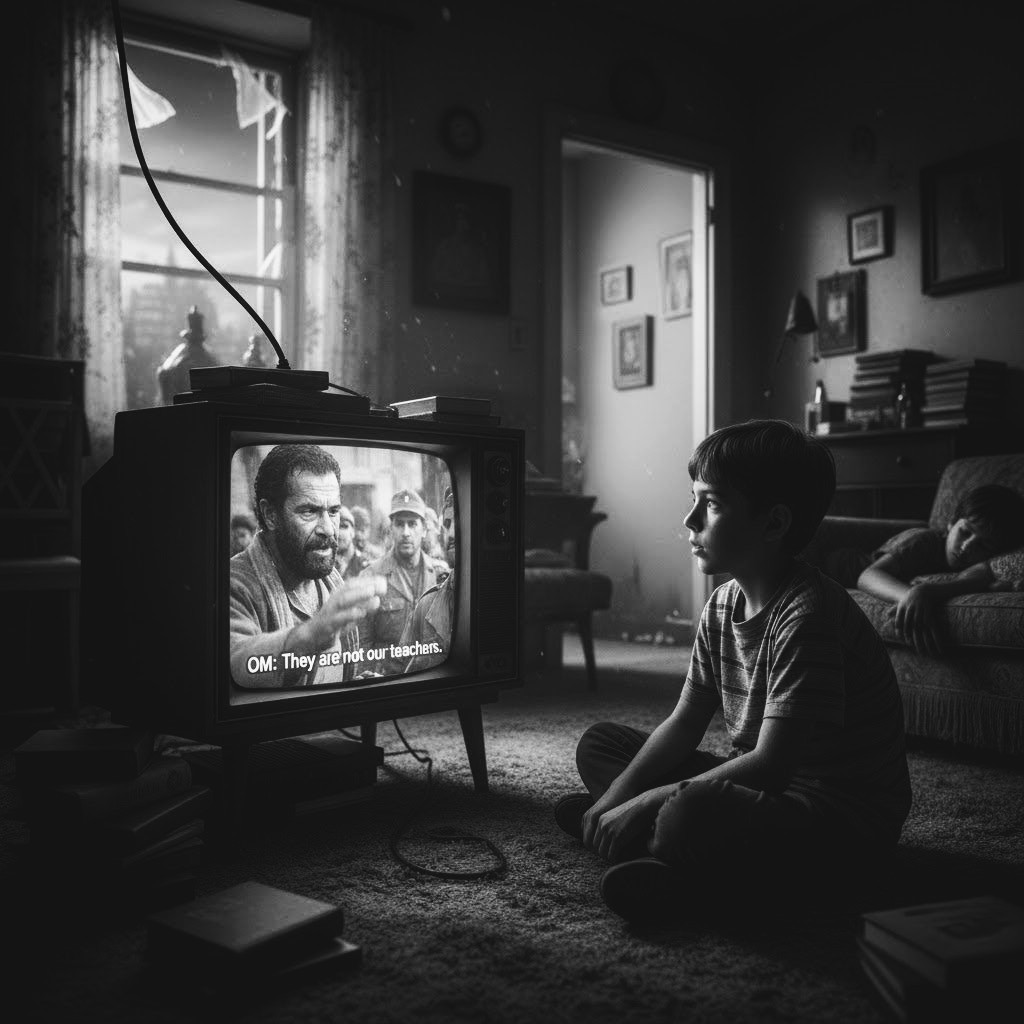
    In the mid-90s, Icarus was a boy of twelve, living in the gravity of the lower middle class, a term that, in a third-world city, meant you weren’t starving, but you were always one broken appliance away from a crisis. His family occupied the first floor, while their ambitions, and their entertainment, hung somewhere above them.

    Because they couldn’t afford a VCR, a single coaxial cable served as their umbilical cord to the world. It dangled from a neighbor’s window on the third floor, swaying in the wind, a thin black line connecting their aging TV to a machine they didn’t own. It was a fragile setup, a makeshift wing held together by luck and neighborhood grace.

    His third brother, Theopompus, was the one who brought the fuel for these flights, tapes from the university movie club. He was the one who provided the means to see beyond their cramped apartment. Today, they are separated by oceans and decades, two points on opposite sides of the globe, the bond between them having long since melted away.

    But one afternoon, the screen flickered to life with Lion of the Desert. As Icarus watched Anthony Quinn’s Omar Mukhtar lead his people against the Italian occupation, he encountered a truth that felt like heat against his face.

    The scene was a crucible: Libyan rebels had captured Italian soldiers. Seeking a blood-debt for their fallen kin, a soldier moved to execute the prisoners. Mukhtar stopped him with a command that carried the weight of a mountain.

    “They are not our teachers.”

    For the boy named Icarus, those words were the “sun.”

    In the myth, the sun is a destructive force that brings Icarus crashing down. But for this Icarus, the words provided a different kind of heat. They burned away the easy justifications of hate. He realized that to soar above one’s enemy, one must refuse to mimic them. If you use the enemy’s cruelty as your map, you aren’t flying toward freedom; you are just falling into a different kind of darkness.

    To stay aloft, he had to remain untainted by the shadow of those he fought. He learned that day that the highest flight isn’t about physical distance or wealth, it is the distance you maintain between your soul and the base instincts of revenge.

    The cable eventually came down, the TV eventually died, and the brothers went their separate ways. But that sun, the realization that we are defined by what we refuse to learn from our enemies, never stopped burning.

  • Prelude: Hello? Is Anybody There?

    Prelude: Hello? Is Anybody There?

    Tracing the Echoes of a Digital Ghost

    Read on Substack

    Sometime in 2001, Icarus started his first blog. Was it on Blogspot? Blogger? Maybe WordPress. No one really remembers. It was a long time ago. Over the years, there were many blogs, across all three places, each one a place to pour out thoughts, questions, and fragments of himself.

    Now, almost twenty-five years later, after a ten-year silence, he was starting again. This time, not a blog so much as a memoir.

    The world had changed over the past quarter century. So had he. He was now a middle-aged father, living half a world away from where that first blog was written. Blogs were no longer read. Long posts were no longer fashionable.

    Why come back? 

    It felt like the opening line of a book he’d read in grade eight… or maybe seven: “Hallo? Er det noen her?” (Hello? Is anybody there?) A novel by one of his favorite authors, Jostein Gaarder.