
Falling is easy; failing yourself is the true descent
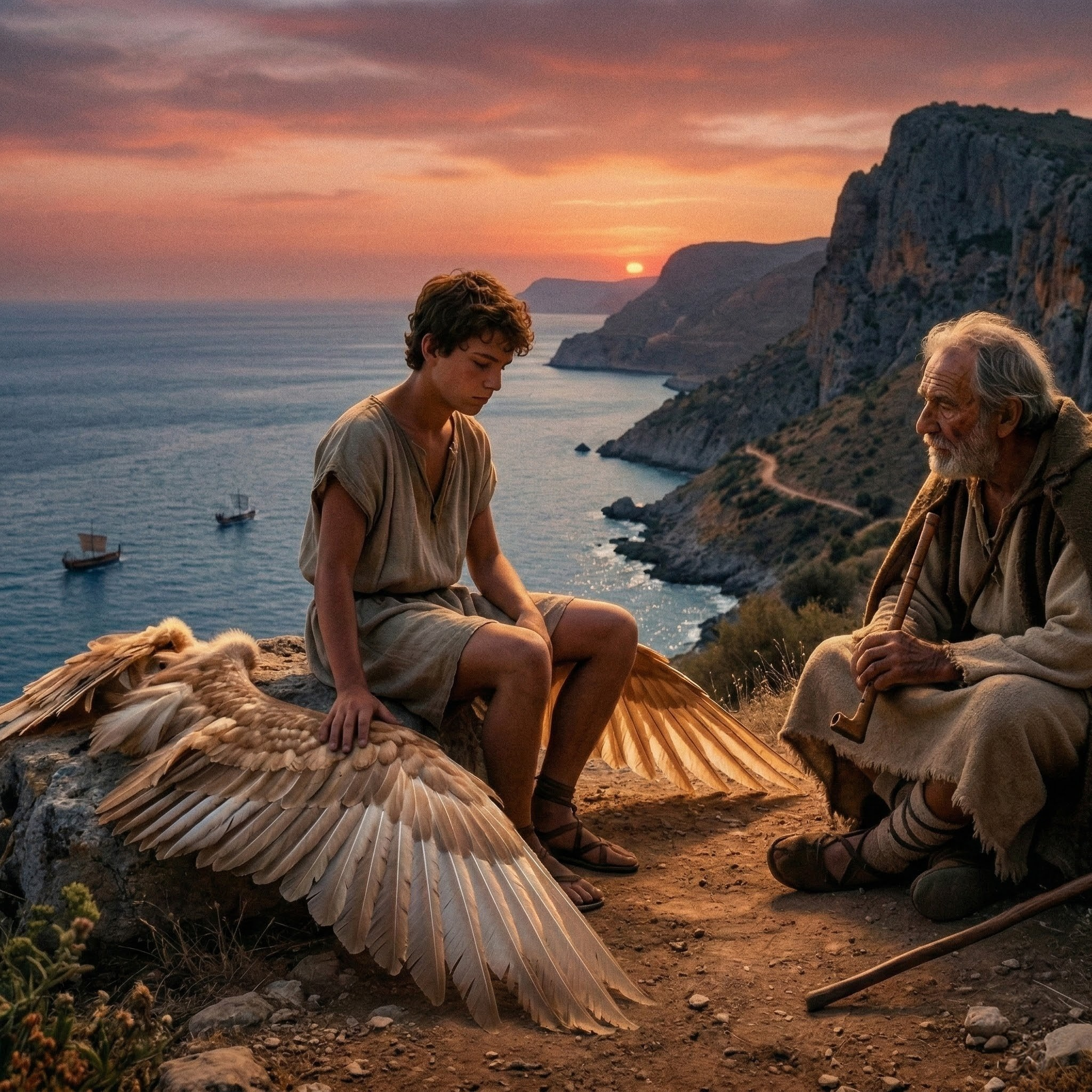
The sun was beginning its slow descent toward the Aegean, casting long, amber shadows across the cliffs of Crete. Icarus sat on the edge of the precipice, his fingers absently tracing the wax seals on the magnificent wings his father, Daedalus, had fashioned.
Nearby, an old shepherd sat among his flock, the same silent fixture Icarus had seen every day of his confinement. Usually, the shepherd was occupied with his pipe, but today, the instrument lay silent in his lap. For the first time, their eyes met, and the silence broke.
“My father says these wings are my salvation,” Icarus said, his voice tight with the restless energy of youth. “He says they are the ultimate triumph of man over nature.”
The shepherd looked at the intricate feathers, then back at the boy. “Your father is a builder of labyrinths and wonders. But he forgets that the heaviest cages are the ones we build for our own expectations.”
The old man leaned back against a jagged stone. “There was a man once, not a lord or a hero, but a thief named Aitheron. Perhaps you’ve heard the name whispered in the markets. When he was your age, bursting with the same fire I see in you, he made a pact with his own soul. He asked himself: ‘Can I rob a thousand caravans by my own hand?’”
Icarus paused, his hand hovering over a golden feather. “A thousand? That’s an impossible feat for one man.”
“With that one question,” the shepherd continued, “he took his life in his hands. He didn’t sleep; he didn’t love. He hunted. And by the time the gray crept into his beard, he had done it. He had robbed a thousand caravans.”
The shepherd’s gaze turned toward the sun. “But when he grew old, the weight of the gold felt like lead. He sought repentance. He told himself, ‘Aitheron, you have conquered a thousand enemies. Now, can you do the simplest thing? Can you escort just one caravan to its destination, safely and alone?’”
“And did he?” Icarus asked.
The shepherd’s face fell into a mask of deep, hollow sorrow. “He couldn’t. The habit of the hunt was too deep, or perhaps his spirit had simply withered under the sun of his own ego. He failed. He didn’t just lose the caravan; he lost the vision of who he thought he had become.”
The old man looked directly at Icarus, his eyes reflecting the flickering light of the wax.
“He disappointed himself,” the shepherd whispered. “The King could have thrown him in a dungeon, or the gods could have struck him blind, but he found those to be mercy. Tell me, boy; is there any punishment more grave than looking into a mirror and seeing someone you no longer respect?“
Icarus looked down at the wings. They felt suddenly heavier, not like a gift of flight, but like a test he was already failing.
[Read from the beginning: Chapter 1: The Wax and the Wire]