
For Those who Burn the World to Build a Throne of Ash
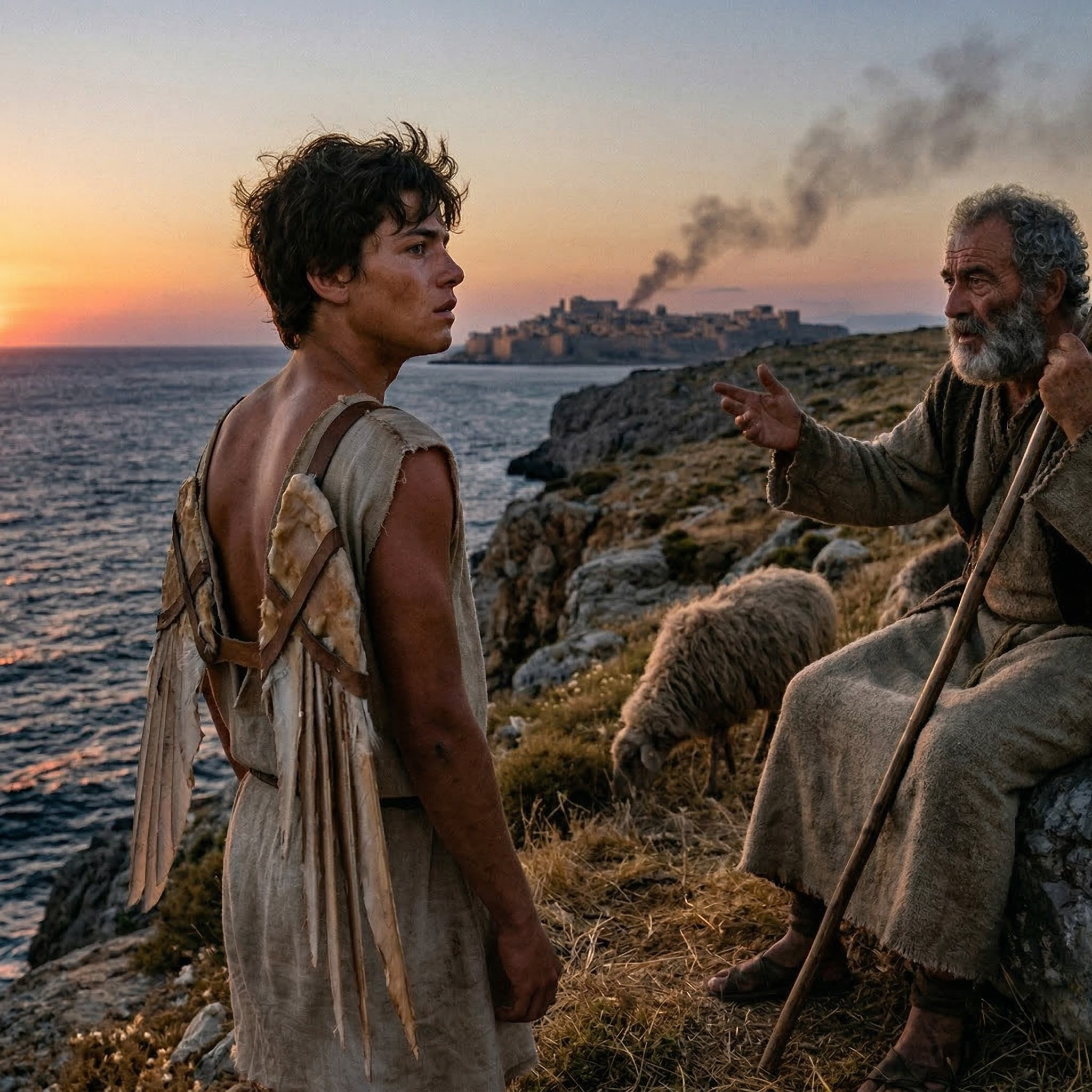
The sun sat low, casting long, skeletal shadows across the rocky crags of Crete. Icarus, still flush with the youthful adrenaline of his father’s latest inventions, looked out toward the distant city-state of Minos. News had traveled fast on the wind: a rising leader, a man named Cleon, had seized control by betraying his own council, claiming that a unified city was worth a few broken oaths.
“They call him a pragmatist,” Icarus said, kicking a loose stone over the cliffside. “My father says Cleon sees the world as a map, and he is simply drawing the shortest line to peace. If a few innocent men must be silenced to prevent a civil war, isn’t the silence a gift?”
The shepherd didn’t look at the horizon. He was busy rubbing a thick salve into the leg of a ewe that had been caught in a thicket. He didn’t speak until the animal was comfortable.
“Your father is a builder of things, Icarus. He understands wood, wax, and gravity,” the shepherd said, wiping his hands on a rough burlap cloth. “But he does not always understand the rot that starts in the soul. This Cleon you admire… he is a man who has decided that the destination is holy and the path is irrelevant. There is no man more dangerous in all of Greece.“
Icarus frowned, leaning against a gnarled olive tree. “Dangerous? He ended the food riots. He stabilized the currency. Surely the ‘end’, a prosperous city, is what matters most?”
“Listen to me, boy,” the shepherd said, his voice dropping to a gravelly skin-prickle. “When a man decides the end justifies the means, he stops being a person and becomes a storm. To him, you are not a friend, a son, or a soul. You are a tool or an obstacle. If you are a tool, he will use you until you break. If you are an obstacle, he will crush you without a second thought, all while whispering that he does it for ‘the greater good.’“
He stepped closer to Icarus, his eyes hard as flint.
“Avoid these people. Do not break bread with them. Do not let their logic infect your heart. They believe they are soaring above the petty ‘limitations’ of morality, much like the wings your father builds. They think they are closer to the sun because they have shed the ‘weight’ of their conscience.”
The shepherd pointed toward the smudge of smoke on the horizon where Cleon’s “order” was being enforced.
“The danger is not just what they do, but what they make you do.” the shepherd continued. “They will ask you to hold the torch while they burn the house, promising you a room in the palace they plan to build. By the time the palace is finished, you’ll find you’ve lost the ability to live in a house that isn’t made of ash.”
“He thinks he is saving us,” Icarus whispered, looking at the distant fires.
“He thinks he is the sun,” the shepherd corrected. “And anyone who thinks they are the sun will eventually scorch everyone who dares to stand in their light. Stay in the valley, Icarus. The air is cooler here, and the paths, though long and winding, are paved with the truth of each step, not the ghosts of those we stepped upon.”
[Read from the beginning: Chapter 1: The Wax and the Wire]