
High Altitudes on a Borrowed Signal
In the mid-90s, Icarus was a boy of twelve, living in the gravity of the lower middle class, a term that, in a third-world city, meant you weren’t starving, but you were always one broken appliance away from a crisis. His family occupied the first floor, while their ambitions, and their entertainment, hung somewhere above them.
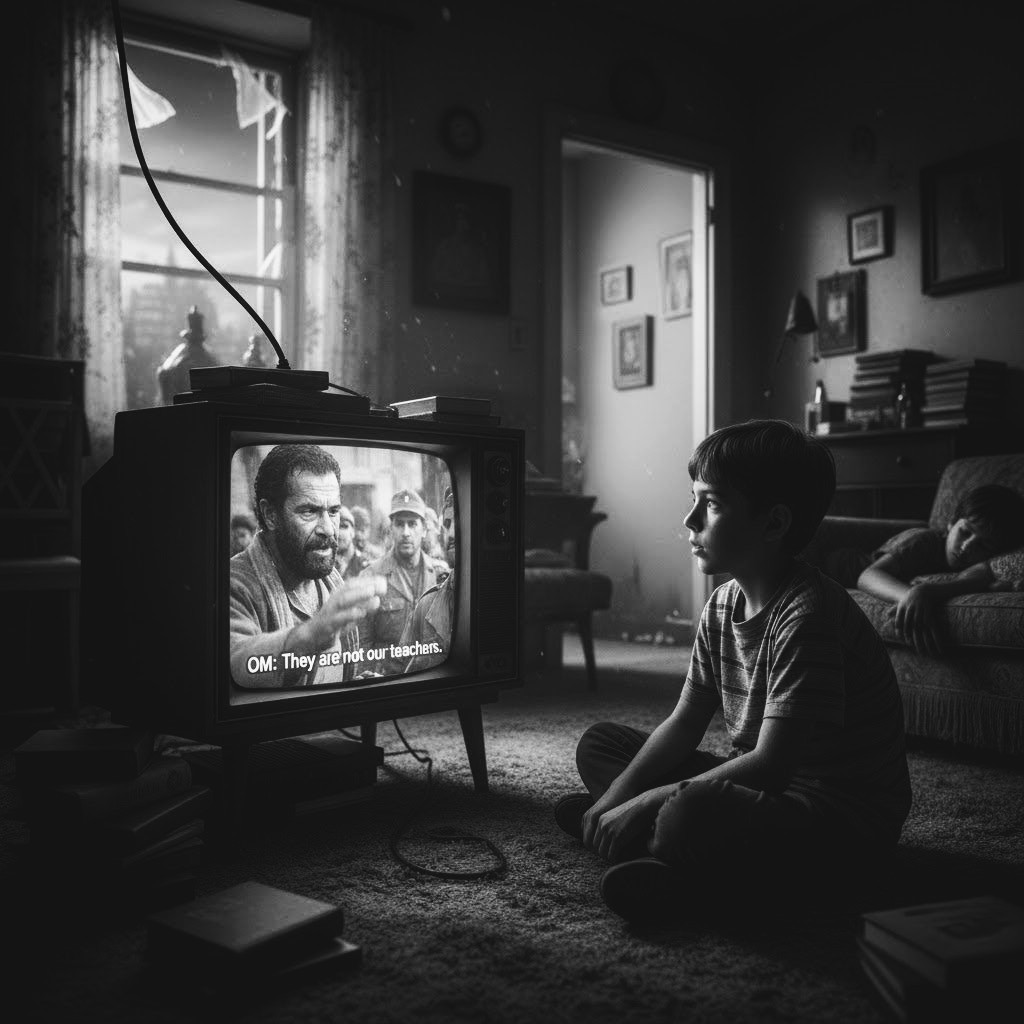
Because they couldn’t afford a VCR, a single coaxial cable served as their umbilical cord to the world. It dangled from a neighbor’s window on the third floor, swaying in the wind, a thin black line connecting their aging TV to a machine they didn’t own. It was a fragile setup, a makeshift wing held together by luck and neighborhood grace.
His third brother, Theopompus, was the one who brought the fuel for these flights, tapes from the university movie club. He was the one who provided the means to see beyond their cramped apartment. Today, they are separated by oceans and decades, two points on opposite sides of the globe, the bond between them having long since melted away.
But one afternoon, the screen flickered to life with Lion of the Desert. As Icarus watched Anthony Quinn’s Omar Mukhtar lead his people against the Italian occupation, he encountered a truth that felt like heat against his face.
The scene was a crucible: Libyan rebels had captured Italian soldiers. Seeking a blood-debt for their fallen kin, a soldier moved to execute the prisoners. Mukhtar stopped him with a command that carried the weight of a mountain.
“They are not our teachers.”
For the boy named Icarus, those words were the “sun.”
In the myth, the sun is a destructive force that brings Icarus crashing down. But for this Icarus, the words provided a different kind of heat. They burned away the easy justifications of hate. He realized that to soar above one’s enemy, one must refuse to mimic them. If you use the enemy’s cruelty as your map, you aren’t flying toward freedom; you are just falling into a different kind of darkness.
To stay aloft, he had to remain untainted by the shadow of those he fought. He learned that day that the highest flight isn’t about physical distance or wealth, it is the distance you maintain between your soul and the base instincts of revenge.
The cable eventually came down, the TV eventually died, and the brothers went their separate ways. But that sun, the realization that we are defined by what we refuse to learn from our enemies, never stopped burning.